
Buying Tools Is Not Transforming: What 81 Studies Reveal About Why SME Digitalization Stalls
A review of post-COVID research (2020–2024) by Kargas finds that the value of digital investment depends less on the technology and more on what leaders build around it.
The Paradox Behind the Investment
In theory, digital transformation should raise revenue. In practice, the evidence often disagrees. Studies cited in a new systematic review by Antonios Kargas and colleagues at the University of West Attica found that revenues were frequently lower than expected after major digital investments. The researchers call this pattern the digitalization paradox.
The review screened 3,657 records from four academic databases and kept 81 peer-reviewed studies on how SMEs digitalized between 2020 and 2024. The authors then applied text-mining and topic modeling to more than 87,000 word pairs to identify which factors genuinely enable or block progress.
The starting point is uncomfortable. SMEs still lag well behind large firms, and the smaller the company, the less likely it is to adopt new digital solutions at all. Any organization that runs on limited budgets, thin talent pools and competing priorities faces the same exposure. That includes a business unit inside a larger group. For these organizations the question is not whether to digitalize. The question is why so much digital spending fails to turn into performance.
From Survival Tools to Strategic Capability
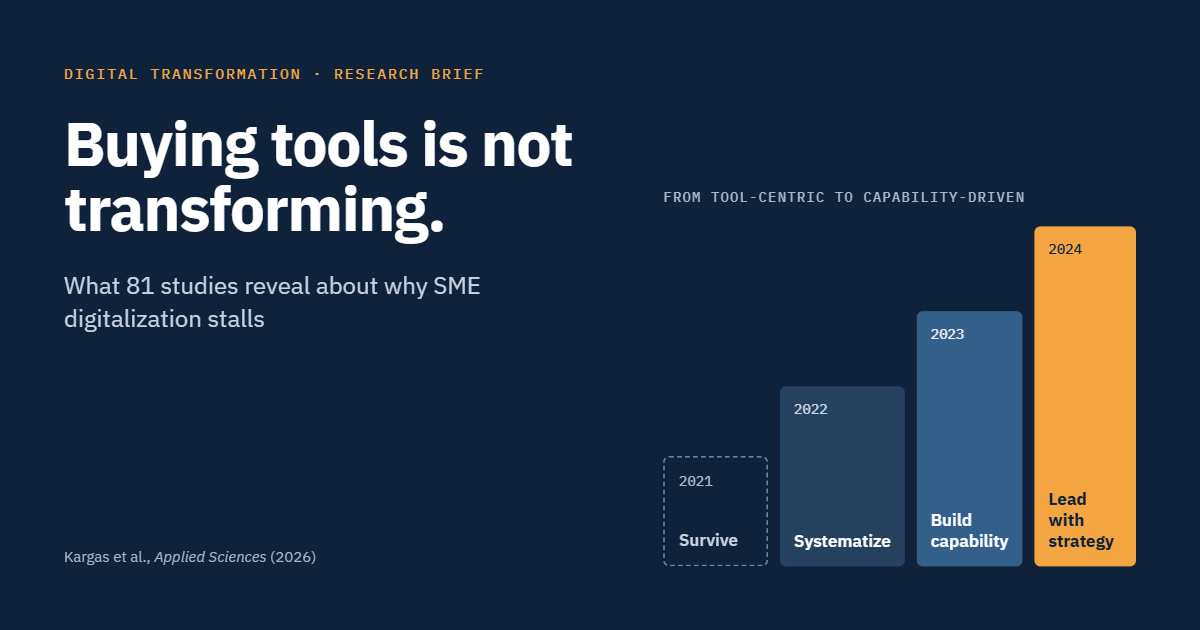
The most revealing finding is how the research focus itself changed over four years:
2021: Studies centered on immediate reactions such as basic digital tools, remote work and business continuity. They showed weak links to strategy or performance.
2022: The emphasis moved to systematic technology adoption, process digitization and early use of data. Digital transformation began to be treated as an organizational issue, not just a technical one.
2023: Capabilities and organizational learning became tightly connected to performance outcomes. The shift was from _using tools_ to _building capabilities_.
2024: Strategy, top-management leadership, external partnerships and digital maturity formed the densest cluster of all.
This trajectory explains the paradox. The review confirms that technological readiness alone cannot guarantee successful transformation. Leadership, strategic alignment and organizational culture act as the mediating mechanisms between digital investment and business performance. If those mechanisms are missing, technology is installed but value does not follow. Two of the nine themes the analysis identified, _human resources and digital maturity_ and _dynamic and digital capabilities_, point to the same conclusion. Results depend on the organization’s ability to integrate technology through continuous learning, not on the technology itself.
The barriers are familiar: limited finance, a shortage of skilled people, resistance to change, higher risk aversion, and complexity that spans many interconnected systems. The paper’s insight is that culture acts as an _early-stage_ gate. Culture decides whether digital tools are used only to survive the short term or are used to support innovation and growth.
The enablers come largely from outside the firm. They include government programs that lower financial barriers, universities and innovation hubs that develop skills, and partnerships with technology providers, international networks and even larger firms. The authors argue that SMEs should stop trying to transform alone.
Executives should note the limitation. The corpus leans toward European and manufacturing-oriented SMEs, so the patterns need local validation before they are applied to other markets and service sectors.
The pattern that ties these findings together is straightforward. Digital value comes from integration capability, not tool acquisition.
The Executive Agenda: Capability Before Technology
The evidence suggests five decisions for leaders:
1. Define before you buy. Set strategic priorities, required capabilities and expected business outcomes _before_ adopting technology. The authors warn specifically against adopting tools first.
2. Fund people and process alongside technology. A digital budget that covers licenses but not skills and process redesign repeats the paradox.
3. Treat culture as the first milestone, not the last. Resistance to change and missing digital skills block adoption long before the technology does.
4. Build an ecosystem. Use public programs, academic partners, technology providers and alliances to offset limited internal resources.
5. Match the plan to your maturity stage. Less mature firms need basic skills and infrastructure first. Digitally mature firms gain more from advanced analytics, automation and data-driven business models.
The 2021–2024 shift was from reactive, tool-centric digitization to strategically planned, capability-driven transformation. Most organizations have already bought the tools. Fewer have built what makes those tools pay off.
If your board asked tomorrow which of your digital investments has actually changed a business result, and which capability made that possible, could you answer?